
Solving Projectile Motion Problems: The Ultimate Step-by-Step Physics Guide

If you are preparing for your high school or pre-university physics exams, you already know that solving projectile motion problems is one of the most common hurdles you'll face.
Whether it’s a football flying through the air, a tennis ball served over a net, or a stone launched from a cliff, tracking an object moving through two dimensions can feel incredibly overwhelming. You have horizontal distances, vertical heights, launching angles, and shifting velocities all changing at the exact same time.
However, the secret to solving projectile motion problems with absolute confidence comes down to one fundamental rule: The horizontal and vertical components of motion are completely independent of one another. In this comprehensive guide, we will break down the essential equations, explain how to resolve vectors, and give you a foolproof framework to conquer any kinematics exam question.
The Golden Rule: Split Your Universe Into Two
The absolute biggest mistake students make when tackling a test question is plugging horizontal distances into vertical velocity equations. To keep your work clean, you must immediately separate your data into two completely independent columns:
Horizontal Motion (x-axis): Because we ignore air resistance in standard physics modules, there is zero acceleration in the horizontal direction (ax = 0). This means the projectile travels at a constant velocity the entire time it is in the air.
Vertical Motion (y-axis): The moment an object leaves the launcher, it is under the constant pull of gravity. It experiences a constant downward acceleration (ay = -g, or -9.8 m/s² on Earth). The object slows down as it rises, stops for a split second at its highest peak, and speeds up as it falls back down.
The only variable that bridges these two completely separate columns is Time (t). Time is your anchor.
Step 1: Resolve Your Initial Velocity Vectors
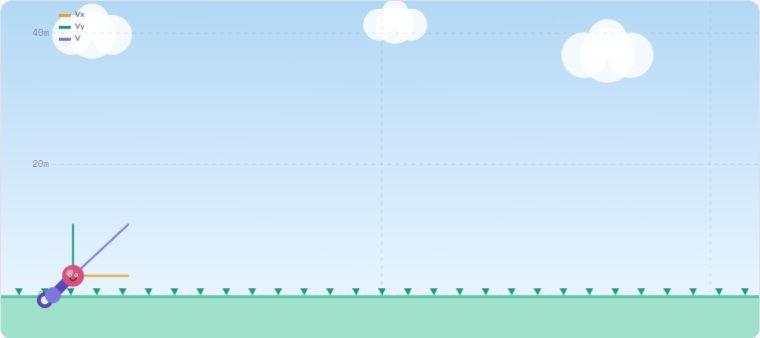
Most exam scenarios give you a starting launch speed (v₀) and an angle (θ) relative to the flat ground. Before diving into calculations, break that angled vector into its pure horizontal (vx) and vertical (vy) parts using standard trigonometry:
Horizontal Initial Velocity: vx = v₀ × cos(θ)
Vertical Initial Velocity: vy = v₀ × sin(θ)
💡 Visual Learner? You can test exactly how changing your launch angle or speed shifts these vector lines in real time using our interactive Projectile Motion Simulator and Virtual Lab.
Step 2: Choose Your Kinematics Equations
Once your vectors are split, match your target variable to the correct axis formula.
For Horizontal Calculations (Range):
Since there is no acceleration horizontally, the formula is simple:
Distance = Velocity × Time
x = vx × t
For Vertical Calculations (Height and Flight Time):
Because gravity creates a constant acceleration, you must rely on standard kinematic equations:
Vertical Displacement: y = y₀ + (vy × t) - (0.5 × g × t²)
Final Vertical Velocity: v_fy = vy - (g × t)
(Where y₀ is the initial starting height, and v_fy is the final vertical velocity at time t).
Step 3: A Foolproof Framework for Solving Projectile Motion Problems
When you are stuck on a complex exam paper, use this reliable sequence to clear the path:
Sketch the Trajectory: Quickly draw the path. Mark whether it starts on flat ground (y₀ = 0) or an elevated ledge (y₀ > 0).
Set up X and Y Columns: List every known variable (vx, ay = -9.8, target displacement) so you don't cross-contaminate your data.
Solve for Time (t) First: If time isn't explicitly given, find it using the vertical data. For instance, set the final vertical velocity to zero (v_fy = 0) to find the time it takes to reach maximum peak height.
Bridge the Axis: Use that shared value of t to calculate your final horizontal distance or impact speed.
🚀 Stop Memorizing, Start Simulating!
Staring at equations on a page can only take you so far. The fastest way to build an intuitive grasp of kinematics is to watch the physics happen in real time.
We’ve built a free, high-fidelity interactive tool tailored specifically to help students verify their calculations and master vector paths.
🎯 READY TO CRUSH YOUR KINEMATICS EXAMS?
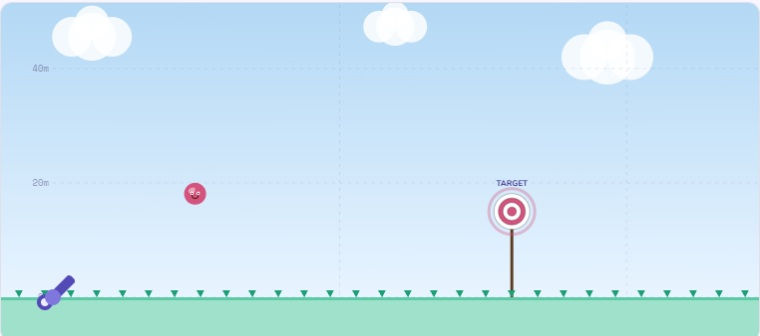
Don't just read about trajectories—control them! Use our online simulator to:
Adjust launch parameters and instantly map the resulting parabolas.
Toggle between different planetary gravity profiles (Earth, Mars, the Moon).
Practice your calculations using our integrated "Target Challenge Game Mode."
Whether you want to verify your physics homework steps or you are preparing for a classroom practical lab assessment, running a few fast virtual experiments makes checking your work effortless. Bookmark the tool, practice a few target runs, and master your 2D motion today!


Comments